

Bee Venom in Skincare: What It Actually Does
Apr 23, 2026
If "bee venom" makes you picture a swollen ankle and a panicked trip to the ice pack, you're not alone.
It sounds intense. A little gimmicky, even.
But in small, cosmetic-grade doses, and paired with the right supporting ingredients, bee venom can be a surprisingly elegant way to support your skin's natural repair process without wrecking your barrier. I didn't add it to our Repair Mask for shock value. I added it because of what I've watched it do in my treatment room on real skin, and what the research shows about how it works.
If you have reactive, over-treated, or just tired skin, this is the kind of ingredient story worth understanding before you write it off.
What is bee venom in skincare?
Cosmetic bee venom is a purified, micro-dose ingredient blended into skincare formulas at concentrations so low you'd never feel anything close to what a real sting feels like. At most, you might notice a light tingle when a mask goes on. That's it.
The main active compound, melittin, has been studied for its anti-inflammatory properties and its ability to prompt the skin's natural repair signaling. When formulated properly, it works with sensitive skin rather than against it.
Bee venom has been studied for years in the context of wound healing, inflammation, and skin renewal. That's the research lineage I care about, not the buzz around it.
How is bee venom collected for skincare?
The ethical sourcing question comes up a lot, and it should. The industry-standard method places a glass plate near the hive with a mild electrical pulse running through it. The current prompts bees to sting the glass in defense, depositing small amounts of venom on the surface. Because glass is smooth (not skin), their stingers don't get stuck, so they don't lose them, and they return to the hive. The venom gets purified and formulated. No bees are killed in the process.
Is it completely stress-free for the colony? Probably not, and I don't want to pretend otherwise. But compared to the alternatives for sourcing standardized, research-grade bee venom, this method is the one that keeps the bees alive and the hive intact. If that line matters more to you than the skincare benefit, I respect that, and this mask isn't for you.
How does bee venom support your skin barrier?
Here's the part most "bee venom masks" on your feed skip over.
Bee venom works by giving your skin a low-level signal that something needs attention. Your skin responds by gently boosting circulation and its own repair activity in the area. Think of it as a whisper to your cells, not a shout. You're not stripping anything. You're not exfoliating off layers. You're nudging the skin toward its own renewal process.
That matters because most of the "results-driven" ingredients on the market work by removing something. Acids dissolve. Retinoids accelerate turnover. Physical scrubs abrade. All useful in the right context, but all adding to the workload of skin that may already be inflamed or compromised.
Bee venom takes a different route. It supports what your skin is already trying to do, which is why it tends to play well with sensitive and reactive skin types when it's formulated thoughtfully.
Bee venom vs. harsh actives like retinol and acids
If you've been in the skincare rabbit hole, you've probably layered your way through AHAs, BHAs, retinol, vitamin C, and whatever the latest "must-try" is. Your skin got thinner, redder, more reactive. You Googled "damaged skin barrier" at 1am. (I hear this story every week in the clinic.)
Harsh actives have their place. But for skin that's already in repair mode, adding more force usually makes things worse. That's where a well-formulated bee venom mask earns its spot. It supports repair without demanding anything from skin that's already running on empty.
This isn't an ingredient for someone trying to smooth a single breakout overnight. It's for people who've realized their routine has been fighting their skin and want to try something that works with it.
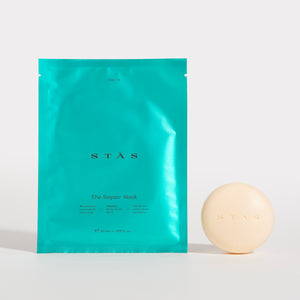
For a deeper look at the full ingredient story, see our breakdown of the Repair Mask.
Who should skip bee venom in skincare?
Straightforward: if you have a known bee allergy, don't use it. That's non-negotiable.
If you're pregnant, immunocompromised, or on medication that affects your immune response, check with your doctor first.
For everyone else, a patch test on the inside of your wrist or behind your ear is a smart starting point, especially if your skin has been extra reactive lately.
What's inside the STĀS Repair Mask beyond the bee venom?
Bee venom is one part of the formula, not the whole story. A mask with bee venom and nothing else would be a novelty product. The repair work happens because of what surrounds it.
Our Repair Mask is formulated with:
- 16 amino acids (the building blocks your skin uses to rebuild)
- Ceramide 6 II (helps reinforce the barrier)
- Glutathione (an antioxidant that supports brightness and skin health)
- Honey and hyaluronic acid (for hydration and soothing)
- Vitamins B and E (antioxidant support)
The bee venom is the gentle signal. Everything else is the raw material your skin uses to respond to it.
The formula was developed alongside my co-founder Arthur Hsia, whose background is in wound-healing research. That lineage shapes how we think about every ingredient. The question isn't "what's trending." The question is "what does skin actually use to repair itself."
How to use a bee venom mask safely
Once or twice a week is the sweet spot for most skin. Three times if you're actively recovering from something like a retinol overuse phase or a harsh winter.
Apply on clean, dry skin. Leave it on for 20 to 30 minutes. Press any remaining serum into your neck, décolleté, and the backs of your hands. Skip your usual active serums on mask nights so the formula can do its thing.
Pro tip: keep the mask in the fridge before use. The cool temperature feels incredible on inflamed or flushed skin.
A light tingle is normal. Stinging, burning, or redness that doesn't fade is not. If that happens, take it off and rinse with cool water.
What results can you expect from a bee venom mask over time?
I'll be honest with you because that's the only way I know how to do this. You're not going to put on one mask and wake up with different skin. That's not how any real repair ingredient works.
What you can expect, with consistent use, is skin that looks calmer, smoother, and more balanced. The appearance of redness tends to fade. Texture looks more even. Your skin feels like it's coping better with everything you throw at it. That's the quiet kind of result that compounds.
The Repair Mask has sold out three times because that's the feedback we keep hearing. Not "this changed my life in a week." More like "my skin finally feels like it's on my side."
The bottom line on bee venom mask benefits
Bee venom in skincare isn't a stunt. It's an old, well-researched ingredient that got a flashy marketing moment. The formulation around it is what separates a meaningful product from a trend piece.
If you've been skeptical, good. Skepticism is how you stop wasting money on skincare that doesn't work. Now you have the information to decide if this is the kind of repair your skin has been asking for.